I was recently discussing with a group about the transition from drawing to sculpture, and the possibility of losing the energy that exists in the drawing when the final product is made. We referenced the drawings of Claes Oldenburg, and how his sculptures, as powerful as they are, may not be as personal as the drawings they developed from. I think our imaginations allow us to construct images that lay outside the bounds of reality, and drawings give us an outlet to share these ideas in a way that sculpture cannot. Unfortunately, sculptures must exist, and therefore they are bound to the physical properties of their materials, and of nature. The lighter side to this debate may be using technology to have our cake and eat it too. This interactive computer system developed by this Swedish company lets users draw objects in the air, in three dimensions, and see what they've drawn on the screen. The company will then prototype the drawing out of actual plastic. Not sure I'd want to sit on that chair though...
Lately it seems BMW has taken an interest in the arts. This is a commercial for the new 5 series, utilizing a kinetic sculpture recently installed in BMW's museum in germany. The piece was commissioned by BMW, and was built by a group called ART+COM.
"714 metal spheres, hanging from thin steel wires attached to individually-controlled stepper motors and covering the area of six square meters, animate a seven minute long mechatronic narrative."*
BMW's connection with art dates back (at least) to the mid 70's with their "Art Cars" These cars are considered "rolling canvases" and are treated as such. They have been painted by some very popular contemporary artists including Warhol (above) and Rauschenberg. Supposedly, Jeff Koons is going to be the next to put his stamp on a BMW, the car has not yet been unveiled but a preview image of his concept has been released, which you can see here.
I'll leave off with one last connection between the car company and art. A program that has been featured on PBS recently shows South African artist Robin Rhode using the BMW Z4, modified to spray paint onto the wheels, as a remote controlled brush on a massive canvas. You can read more here, and there is an image below of the car in action. Apparently the technology used was adapted from water jets used on stunt cars to grease up the tires during powerslides. To display the piece, only a small section of the massive canvas is brought to the gallery space, but video of the entire event is shown in it's place.
Galapagos, created by Karl Sims in 1997, is an interactive "Darwin simulator" that lets users play god, by deciding how natural selection will play out for a group of simulated organisms. This blend of natural science and interactivity with artistic endeavors gives the piece a very broad range of appeal. Even today, over a decade after it's creation the idea is fresh, exciting and technologically advanced. Artists will be drawn by the limitless possibilities of design and invention, while the more grounded among us will see the work as a learning tool, and a chance to do in ten minutes what the Earth has been doing for millennia.
"This process of interactive evolution can be of interest for two reasons. First, it has potential as a tool that can produce results that can not be produced in any other way, and second, it provides a unique method for studying evolutionary systems."*
I'm particularly drawn to the idea of randomization and collaboration. I'll take a moment to plug one of my own sculptures, since it seems to be a cousin of Sims' piece. My work utilizes 4 imac computers which all act independently of one another, but collaborate to create cohesive music. Each computer represents one instrument in a jazz band, and has been programed with around 50 different audio clips. The ensemble is timed to begin playing every hour and half hour, and they play for 15 minutes at a time. because of the random patterns of the sound clips from each computer, no two "performances" are alike. The different instruments blend together into a freeform jazz "jam". There are obviously aesthetic similarities between the two pieces, and I'd like to think my own concept is also a stimulating one.
Old media meets new technology when Joshua Allen Harris transforms used plastic bags into lively creatures on the streets of New York. His inflatable sculptures work by attaching the open bottoms to the vents found above the subway tracks all over the city. As the trains pass beneath, the displaced air is forced out, inflating the pieces. Harris describes the life cycle of his animals, here, as a glimpse at life and death as the creature inflates and exists for a short time before deflating, and sagging to the ground again.
We sometimes think of man's industrialization as lifeless and gray, incapable of delivering life. Harris has found a way to harness the motion and wasted energy of our industrialization, the byproduct of the gears grinding under our feet. And importantly, the creatures he creates draw childlike excitement from those who pass it by.
Here's a copy of Rodin's The Thinker in all it's original glory, and only 93,000 times smaller. The Korean scientists responsible were showcasing the latest in laser technology through the language of art. article here
Willard Wigan on the other hand, uses his miniature sculptures to showcase his natural talent. Wigan sculpts inside the eyes of needles or atop the heads of pins. He doesn't use fancy lasers or computer scanners, just a lot of patients and a very steady hand. Each piece takes an average of 3 months to complete.
"The personal sacrifice involved in creating such wondrous, yet scarcely believable, pieces is inconceivable to most. Willard enters a meditative state in which his heartbeat is slowed, allowing him to reduce hand tremors and sculpt between pulse beats. Even the reverberation caused by traffic outside can affect Willard’s work. He often works through the night when there is minimal disruption."*
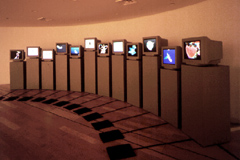
This was an interactive installation piece I was fortunate enough to experience for myself last October at the Cogut Center for the Hmanities, part of Brown University. Rovan has created an intense experience, full of interactivity. The first part, which I was told by the caretaker was built and programmed entirely by the artist, has you placing your hands on metal rails to measure your heart rate. It seems to "size you up" for awhile before bursting into a display of light and sound. As the video wall comes to life, the viewer is also lit up by a spotlight, this gave me the sense that I was involved with what I was seeing on the screen, though I'm not sure the video changes person to person. (several different visual effects played the various times I triggered the event.) I was told that the computer program was written by Rovan using Max MSP which is certainly a powerful enough tool to do it.
The next video wall utilizes a camera, which overlays a shadow of the viewer onto the screen. There is a short delay in the video feed, and a blurring effect which feels almost surreal, a bit like an out of body experience. This is very fitting considering the written content that appears in the viewer's negative. The telegraph sound that the narrator mentions in the video is more than just piped in sound clips. Rovan mounts the antique device on a wall inside the room. The click-clack sounds have a tangible source, and since the room is split by a hanging video screen, the dynamics of those sounds change as you move deeper into the room.
Rovan has managed an impressive level of immersion with his installation. Walking inside and experiencing the room, you get a sense that normal physics no longer apply, that you've crossed into a world of the artist's creating. somehow the lights and sounds become comfortable as you adjust to your surroundings slowly and stepping out seems more disorienting than first going inside. Check out Rovan's website to see what he's working on now, and what we'll see next from him.
This piece called "Augmented Sculpture v 1.0" was created by Pablo Valbuena of Madrid, in collaboration with Medialab Madrid, now called Medialab Prado, a public foundation which brings together art, science and technology with the goal of providing a structure for research and production/development.*
Valbuena's piece begins with a physical structure, which he then shoots a video layer onto using nothing but a normal projector. He states in an interview that simplicity was one of his goals from the beginning, that the piece is about the space (and time) interacting with the viewer. The interview is from 2007, and in it he states that he'd next like to play with scale, and work in an urban environment. Valbuena's Website has some great documentation on what he's been doing since, which includes projecting his Tron-like Augmented realities onto the sides of buildings, and outdoor pavilions, where he utilizes all aspects and nuances of his environments.
Marisa Olson is a German born New Media artist living and working in New York. This piece titled "Black or White" from 2006 is her response to Michael Jackson's song of the same name. It is a part of her "Performed Listening" series, and is an exploration into the role of spectatorship in performance art. In this piece, Olson makes comparisons to the way machines and humans hear sounds. She has used a video filter developed by Nam Jun Paik called a wobulator which reacts to sound, distorting the image on a TV screen.
This piece takes cues from other performance artists, combining aesthetics of early Nam Jun Paik installations with the message and overtones of later artists such as Pipilotti Rist. As the sound pushes her face around the screen, the viewer is able to see how the machine interprets the song. By connecting our own eyes to our ears we feel the music. So are we doing more than just watching Olson listen to the song? The song's content is about transcending cultural preconceptions about race. By showing us how a cold machine hears while we're watching the artist listen, it becomes easy to drop some of those preconceptions about differences and instead think about how much we are the same.