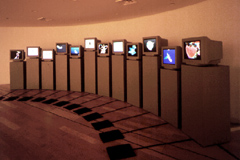
Galapagos, created by Karl Sims in 1997, is an interactive "Darwin simulator" that lets users play god, by deciding how natural selection will play out for a group of simulated organisms. This blend of natural science and interactivity with artistic endeavors gives the piece a very broad range of appeal. Even today, over a decade after it's creation the idea is fresh, exciting and technologically advanced. Artists will be drawn by the limitless possibilities of design and invention, while the more grounded among us will see the work as a learning tool, and a chance to do in ten minutes what the Earth has been doing for millennia.
"This process of interactive evolution can be of interest for two reasons. First, it has potential as a tool that can produce results that can not be produced in any other way, and second, it provides a unique method for studying evolutionary systems."*
I'm particularly drawn to the idea of randomization and collaboration. I'll take a moment to plug one of my own sculptures, since it seems to be a cousin of Sims' piece. My work utilizes 4 imac computers which all act independently of one another, but collaborate to create cohesive music. Each computer represents one instrument in a jazz band, and has been programed with around 50 different audio clips. The ensemble is timed to begin playing every hour and half hour, and they play for 15 minutes at a time. because of the random patterns of the sound clips from each computer, no two "performances" are alike. The different instruments blend together into a freeform jazz "jam".

There are obviously aesthetic similarities between the two pieces, and I'd like to think my own concept is also a stimulating one.


No comments:
Post a Comment